Kaplan’s $40,000 Gold Scenario: The Monetary Case—and the Missing Guarantees
GoldNotes.com | Video analysis | Published 15 November 2026. Interview uploaded 13 November 2026.
Thomas Kaplan’s latest gold argument is not a short-term trading call. It is a wager that debt, currency distrust and demand for assets outside the credit system could eventually force a much larger repricing of bullion.
In an ITM Trading interview with Daniela Cambone, uploaded November 13, the NOVAGOLD chairman says he can see gold rising “10x from here.” ITM’s headline turns that proposition into “Gold to $40,000.” The distinction matters: this is an investor’s scenario, not an independently established valuation, a dated price target or a guaranteed outcome. [1]
Watch the original interview
ITM TRADING, INC. — 41 minutes, 53 seconds. Original: https://www.youtube.com/watch?v=VGLtdkbUKs0
Source context: ITM sells precious metals and the video promotes strategy calls. Kaplan has substantial professional exposure to the sector. NOVAGOLD’s indexed board biography identifies him as chairman and as chairman and CEO of Electrum, which manages a major NOVAGOLD shareholder’s portfolio. Those interests do not invalidate his reasoning, but they belong beside it. This is not independent investment advice. [1,5]
Viewing note: The full interview also includes political commentary and named-person allegations outside this article’s gold-market scope. Those passages have not been independently established here and are not endorsed by GoldNotes. The original video remains attributed to its publisher.
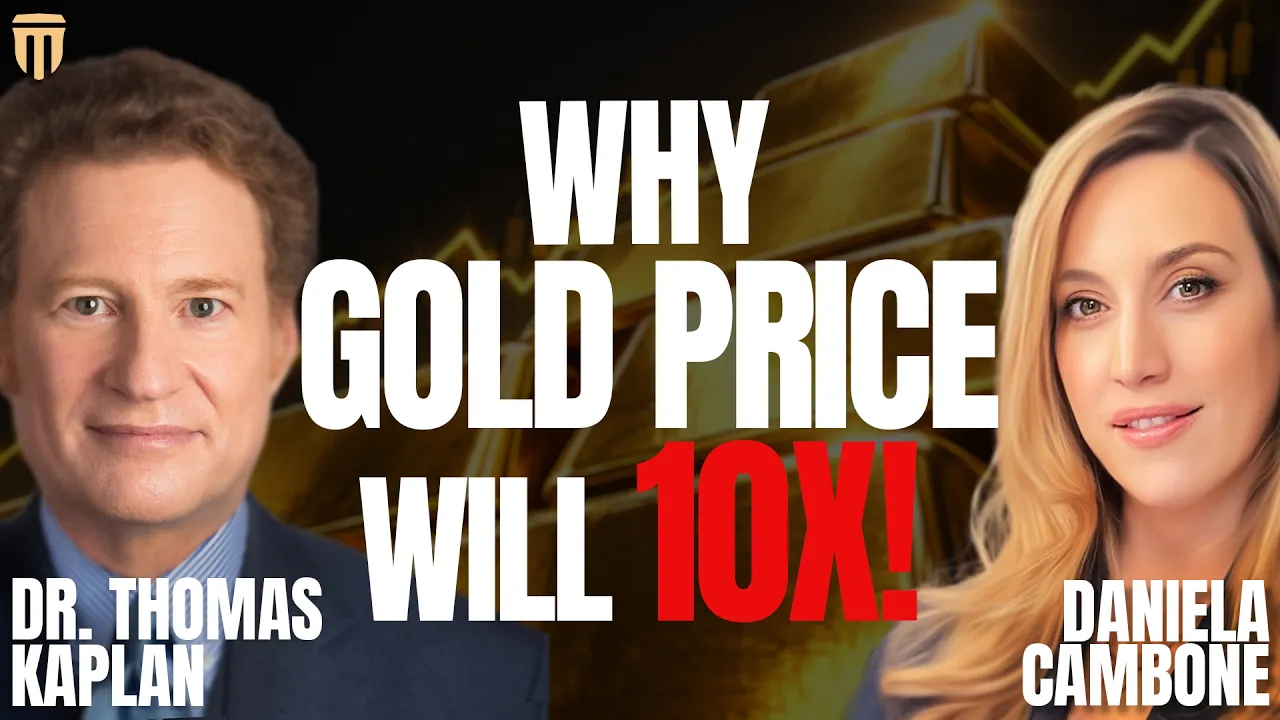
Watch the original interview here
Watch the original on YouTube if the embedded player is unavailable.
What Kaplan is actually arguing
At approximately 7:49, Kaplan connects his tenfold scenario to debt and a possible monetary repricing. He also makes a more practical distinction: owning metal is not the same proposition as owning a mining business.
His preferred mining exposure combines asset quality, grade, production potential and a jurisdiction where investors can retain the benefits. That is a useful due-diligence framework, but not a stock recommendation. Permitting, financing, construction costs, dilution, operating performance and valuation still determine what shareholders receive.
Kaplan also allows for a sharp correction along the way. His “1987 moment” comparison is a historical analogy—not evidence that gold must follow the subsequent path of US equities. Investors should not mistake long-term conviction for protection against near-term losses. [1]
The strongest supporting evidence: official-sector buying
The World Gold Council’s Q3 2026 report estimates net purchases by central banks and other official institutions at 321 tonnes, with estimated buying of 675 tonnes over the first nine months of the year. [2]
That supports the narrower proposition that official institutions continue to value gold. It does not prove that every central bank anticipates a dollar collapse or shares Kaplan’s price outlook.
There is another important boundary: the same report identifies 120 tonnes of reported Q3 net buying, versus the larger estimated total. Its country-level data were captured through October 30 and may be revised. An estimate intended to account for undisclosed activity is not a complete public list of identifiable transactions.
GoldNotes’ separate central-bank evidence review explores those measurement issues. This interview adds a forecast to that discussion; it does not convert the forecast into a finding.
“Not enough to go around” needs a definition
Gold cannot be created by monetary decree, and mine supply cannot respond instantly to a surge in demand. But that is different from establishing an imminent inability to buy bullion.
The Council reports record third-quarter mine production of approximately 1,071 tonnes, up 3% year on year. Total supply nevertheless fell 1%, to approximately 1,369 tonnes, as weaker recycling and producer de-hedging outweighed the increase in mined output. [3]
These data show a market with constraints and competing supply channels—not a simple disappearance of metal. Price, recycling, existing owners’ willingness to sell and the form of demand all matter. A shortage claim needs evidence about a defined product, location, delivery period and price. Kaplan’s broad statement establishes none of those on its own.
A reserve asset is not the same thing as a reserve currency
Kaplan describes gold as the second-largest reserve “currency.” The more precise comparison is with official reserve assets, and it depends on valuation and the categories being compared.
The ECB’s June 2026 report puts gold at 27% of total official foreign reserves at end-2025, above the euro’s 15% and US Treasuries’ 22%. It immediately cautions that the shift largely reflects valuation effects. At end-2023 gold prices, gold and the euro each represent 16%, while US Treasuries remain at 26%. These are historical reserve comparisons, not current market quotes. [4, printed page 14]
US Treasuries are not the whole universe of dollar-denominated reserve assets. Nor does gold’s reserve value mean it has displaced currencies in everyday payments or international credit. The ECB also notes gold’s volatility, lack of interest income, storage costs and limited supply elasticity.
GoldNotes view
The strongest part of Kaplan’s case is the distinction between directly owned bullion and somebody else’s promise to pay. That distinction deserves attention without requiring belief in a particular price forecast.
It also requires attention to ownership structure. A physical bar, an unallocated account, an ETF share, a futures contract and a mining share carry different legal rights, costs and risks. Canadian investors additionally face exchange-rate effects when comparing US-dollar gold prices with Canadian-dollar returns.
The useful questions are therefore practical: What exactly is owned? Who controls custody? What are the costs of entry, storage and exit? How much loss could be tolerated if the forecast is wrong or takes much longer than expected?
Bottom line: Official-sector demand and gold’s monetary characteristics support taking the thesis seriously. They do not establish $40,000 gold, a tenfold return, an imminent physical shortage or a timetable for currency failure.
Educational commentary, not investment advice or a recommendation to buy any security. Gold and gold-linked investments can lose value. No allocation or return is guaranteed.
Sources
1. ITM Trading interview — Thomas Kaplan with Daniela Cambone, uploaded November 13, 2026. Timestamped text recovered through web extraction; title, channel, upload date and runtime corroborated with downloader metadata. Direct subtitle download returned HTTP 429. No full-video copy or playback verification is claimed.
2. World Gold Council — Q3 2026: Central banks, November 3, 2026. WGC is an industry organization; its report attributes estimates to Metals Focus and other named data providers.
3. World Gold Council — Q3 2026: Supply, November 3, 2026.
4. ECB — The international role of the euro, June 2026, printed page 14 / PDF page 15. Original PDF downloaded and verified.
5. NOVAGOLD — Board of Directors. Biography recovered from indexed official-page text; direct page retrieval returned HTTP 403. No current shareholding percentage is inferred.