A gold pan normally holds the promise of a precious-metal discovery. For Yukon placer miner Neil Loveless, it became a temporary resting place for something remarkable: the mummified body of an Ice Age wolf pup. After finding her in 2016, he placed her in a pan and then a freezer until a palaeontologist could examine her.[3]
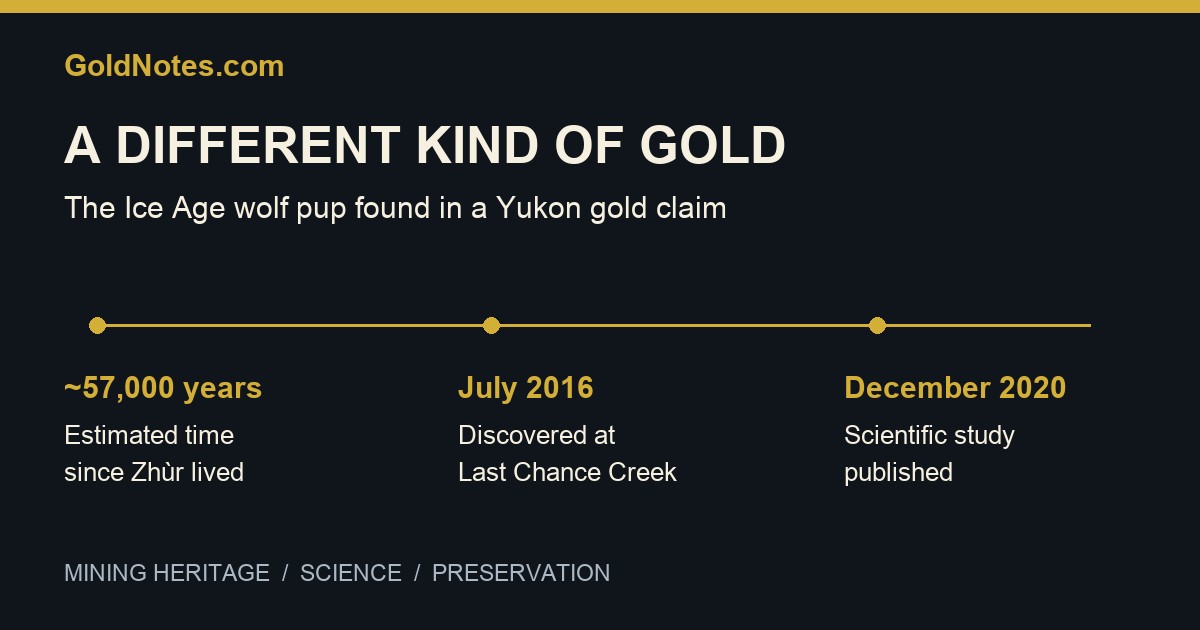
Her name is Zhùr, meaning “wolf” in the Hän language. Tr’ondëk Hwëch’in named her, and scientific analysis later placed her life approximately 56,000–57,000 years ago—with death at just six to seven weeks old.[6]
This is a rediscovered story, not a new 2026 find. Yukon’s official account places the discovery at Last Chance Creek near Dawson in July 2016; the research was published in Current Biology in December 2020.[1][2] A newly circulating Facebook post prompted this GoldNotes look back at the evidence—and at the relationship between gold mining, science and Indigenous heritage.[7]
The miner’s instinct that saved the find
The scientific paper records that the pup was exposed during hydraulic thawing of frozen sediment along a small tributary of Last Chance Creek.[6] Loveless told CBC that he initially thought she might be an old puppy that had fallen down a mine shaft, rather than an animal from the Pleistocene.[3]
That recollection supports the heart of the viral account. The important step was what happened next: the remains were retained for expert examination, rather than discarded as an unremarkable object in the mud.[3]
The result was an unusually complete animal, not just a skeleton. The paper describes preserved skin and fur, even the tiny structures on her lips; it also documents damage to the skin during discovery.[6] “Exceptionally preserved” is therefore more accurate than suggesting an entirely untouched specimen.
What the scientists actually established
Julie Meachen of Des Moines University led the research team assembled by Yukon palaeontologist Grant Zazula, drawing on X-rays, tissue chemistry and ancient DNA.[2]
Her age was estimated, not read from a single exact carbon date. Radiocarbon testing established that Zhùr was more than 50,000 years old. The researchers combined a molecular age estimate from mitochondrial DNA with oxygen-isotope evidence to infer an age of roughly 56,000–57,000 years.[6]
The six-to-seven-week estimate came from skeletal development. X-rays revealed the state of her growth plates and wrist and forelimb bones. The estimate assumes comparable bone-development rates to domestic dogs. The paper also specifically records erupted incisors, baby canines and several baby premolars—so the presence of teeth is not evidence against the researchers’ age estimate.[6]
A collapsed den is the leading explanation for her death. The researchers found no evidence that she starved and concluded that the evidence supported burial when a den entrance collapsed.[6] That is a scientific reconstruction, not an eyewitness account of exactly how quickly she died.
Aquatic food is supported; a precise final salmon meal is less certain. Stable-isotope measurements indicated an important contribution from aquatic resources to her diet and, by proxy, her mother’s. The paper allows for freshwater food or salmon that migrate between sea and rivers. It does not identify a particular fish species from a recovered stomach meal.[6]
That distinction matters: the chemistry tells us about feeding patterns, but the appealing image of one final salmon dinner is more specific than the published evidence supports.
A small wolf with a much bigger family history
Zhùr’s mitochondrial genome grouped with ancient Beringian and Russian grey wolves. The study connects that pattern to movement across the Bering Land Bridge between Eurasia and North America.[6]
Her mitochondrial lineage was not the direct ancestor of wolves living in the region today, supporting evidence of regional population replacement.[6] This is more precise than saying she was simply “unrelated to modern wolves”: the finding concerns a particular maternal genetic lineage and regional history, not the absence of evolutionary relationships.
More than a scientific specimen
The story also belongs to Tr’ondëk Hwëch’in. Yukon’s official account describes collaboration with the First Nation to highlight the cultural importance of wolves and other Ice Age mammals.[1]
CBC reported that Zhùr was brought back to Dawson for a blessing ceremony with Elders and given her name. Debbie Nagano, then the First Nation’s heritage director, explained that respectful treatment needed to extend beyond physical care to spiritual significance.[3]
For GoldNotes, that is central—not an aside to the discovery. A remarkable find involves responsibilities to the people whose traditional territory holds it, as well as opportunities for scientific research.
The Klondike’s other buried treasures
Zhùr is not the only case in which gold mining exposed an extraordinary Ice Age animal. On June 21, 2022, miners at Eureka Creek uncovered a near-complete baby woolly mammoth within Tr’ondëk Hwëch’in Traditional Territory. Elders named the calf Nun Cho Ga, meaning “big animal baby.”[4]
The joint Yukon–Tr’ondëk Hwëch’in announcement credited the recovery to collaboration among the mining team, the First Nation and government specialists. At the time, geologists estimated that the mammoth was more than 30,000 years old.[4] It is a separate discovery, not another name for Zhùr or evidence that the two animals lived together.
These cases illustrate the practical importance of a miner recognizing an unusual find and bringing the right people into its recovery. They are not evidence of richer gold grades, a new mineral resource or an investment opportunity.
What to do if a fossil turns up
Yukon’s published guidance is straightforward: leave the fossil where it is, record its location, photograph it if possible, and contact the Yukon Palaeontology Program and the appropriate First Nation when on its Traditional Territory.[5]
Loveless’s actions are part of the historical discovery account, not a general instruction to pick up, wash or move fragile remains. For present-day discoveries, follow the official guidance and seek specialist direction.[3][5]
The GoldNotes takeaway: the most memorable thing to come out of a gold claim is not always gold. Zhùr’s story is about observation, preservation and cooperation—and the extraordinary knowledge that can survive when a find is treated as more than an object to extract.
GoldNotes.com mining heritage and science feature. Informational only; not investment advice. Published November 8, 2026. The discovery and study dates are distinguished from this article’s publication date.
Sources and further reading
- Government of Yukon — archived 2020 Zhùr announcement
- University of Alaska Fairbanks — research summary, December 21, 2020
- CBC North / Radio Canada International — discovery and cultural context, December 21, 2020
- Yukon and Tr’ondëk Hwëch’in — Nun Cho Ga discovery announcement, 2022
- Government of Yukon — Report a fossil find
- Meachen and colleagues — A mummified Pleistocene gray wolf pup, Current Biology (2020)
- Dailystories — supplied Facebook lead, viewed November 7, 2026